

Coffee is precious trade commodity
In the world trade statistics, coffee is one of the most important commodities.
| South America | approx. | 82 million bags |
| Africa | approx. | 24 million bags |
| North and Central America | approx. | 18 million bags |
| Asia and Oceania | approx. | 54 million bags |
| Total | approx. | 178 million bags |
Each sack actually weighs between 45 and 70 kilos. Statistical assessments are based on a weight of 60 kilos per sack.
Of this world production, some 110 million bags are generally exported. The rest is consumed or stored domestically.
The figures given are average values. The current figures can be found here as a PDF.
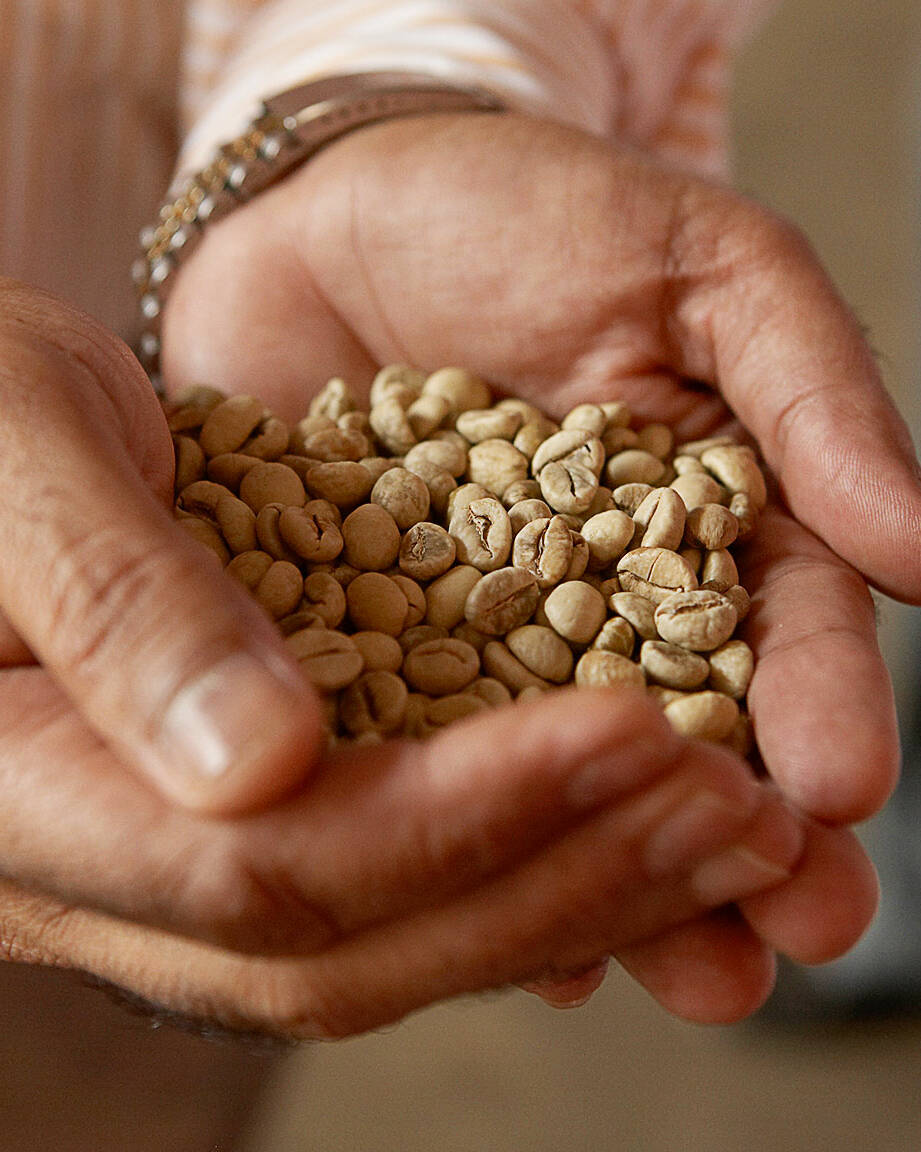
Fine arabica beans presented like precious gems

Trade
Routes taken by coffee in the coffee trade
The normal course run through in the daily coffee trade is illustrated below. Not all stages will necessarily be covered. An exporter may well own his own plantations or processing centres and thus carry out the relevant stages in the country of origin.
Farmer
Processing
Exporter / Cooperative
Trade / Coffee exchanges in New York and London
Importer
Coffee roaster
Consumer
From the main producing countries, coffee is shipped all over the world.
The international coffee trade
Coffee is shipped from the main producing countries to destinations all over the world. Green coffee stocks are stored in almost every large port city in the world. Today, both Coffee Exchanges are trading through an electronic platform, I.C.E. in New York for Arabica-coffee and LIFFE in London for Robusta-coffee.
Price fluctuations are part and parcel of the coffee business, as are unavoidable environmental issues, largely caused by the following factors:
A recent trend has seen exporting countries (especially the regional giant Brazil) develop a growing domestic market, which has increased demand. This development has been further reinforced by the increasing interest in coffee shown by countries that previously did not have much of a “coffee culture”. All this is naturally reflected in the world’s commodities markets.
The basic quality defined and used for commodities-market purposes serves as a general reference for the coffee trade as a whole. Deviations from this rule are reflected in differences with respect to current commodities-market prices. This factor, known as “the differential”, forms an important part of commodities trading in green coffee.
The market price of coffee is subject to discounts and supplements that depend on the quality of the raw coffee and its country of origin.
The international coffee trade is conducted exclusively in US dollars, so any rise in the value of the dollar means more expensive coffee – regardless of the commodities-market price.
Apart from the price of the coffee itself, factors having an effect on the price paid by the consumer include the costs of crude oil, transport, insurance and so on. Various organisations have made efforts in recent years to set up support projects designed to assure coffee producers a more stable income.


Transport
Coffee on the high seas
A long journey awaits the green beans – and a whole string of further processing stages in the consuming countries.
The green coffee is loaded in bags into the containers and thus made ready for shipping. Once in the port, the coffee bags are loaded into the container. The container is loaded onto lorries and driven to the freighter.
It is also common practice nowadays to tip the sacks into a hopper, from where a tube sucks the unprocessed coffee up and blows it into a container. These containers are previously lined with plastic foil, jute or a compact bulk pack made to fit the size of the container. This method is also referred to as “bulk-shipping”.
Import
Coffee arrives in Switzerland from the various producing countries via different sea routes.
Import and consumption in Switzerland
Switzerland imports roughly 199,000 tons of green coffee annually. Of these, some 114,000 tons are processed in Switzerland and re-exported as soluble coffee, decaffeinated coffee or roasted coffee. The domestic consumption currently totals approximately 85,000 tons of green coffee equivalent.
Coffee has a stimulating, positive effect on people and is, even in times of hardship is an indispensable commodity. Thus the Federal Council has ordered Swiss importers to maintain compulsory stocks at all times. For this reason, coffee imports are subject to an import licence system.
The Swiss people drink coffee of a high quality. And, as far as quantities are concerned, they can be classed as ‘heavy’ drinkers.
| Per head consumption of green coffee* |
|||
| Finland | 12 kg | Austria | 6 kg |
| Norway | 10 kg | Italy | 6 kg |
| Iceland | 9 kg | Brazil | 6 kg |
| Denmark | 9 kg | Germany | 6 kg |
| Netherlands | 9 kg | Greece | 6 kg |
| Sweden | 9 kg | France | 6 kg |
| Switzerland | 8 kg | Lebanon | 5 kg |
| Canada | 7 kg | Spain | 5 kg |
*Approximate annual figures


Economic correlations
Source: ICO, USDA/FAS, Statista
- The economic significance of coffee
- Raw coffee price
- Commodity exchanges
- Price fluctuations
- Foreign currency revenues
- Cost factors
- Support programmes